minFraud Release Notes
View as MarkdownDispositions API now pages with a cursor
October 16, 2026The Dispositions API now
takes a cursor parameter and returns a next_cursor value. Send
updates_after on your first request, then send each response’s next_cursor
as cursor. A response to a cursor request holds at most 1000 updated
transactions, even when many updates share one timestamp.
If you page by sending last_update_timestamp as updates_after, your requests
keep working. These changes apply to all requests:
- The response has a new
next_cursorkey. - MaxMind returns an update one minute or more after it happens.
- When
updatesis empty in a response toupdates_after,last_update_timestampis the time of yourupdates_aftervalue, not the current time.
See the Dispositions API documentation for details.
New phone verification inputs
October 15, 2026We have released new inputs for all minFraud web service customers. They describe the most recent verification of the billing or shipping phone number.
| new input | description |
|---|---|
billing/phone_verification_method | The method used for the most recent verification attempt of the billing phone number: network, delivered_code, or other. Learn more on our developer portal. |
billing/phone_was_verification_successful | Whether the most recent verification that the end user controls this billing phone number was successful. Learn more on our developer portal. |
billing/phone_verification_time | The most recent date and time a verification of the billing phone number was attempted, if known. Learn more on our developer portal. |
shipping/phone_verification_method | The method used for the most recent verification attempt of the shipping phone number: network, delivered_code, or other. Learn more on our developer portal. |
shipping/phone_was_verification_successful | Whether the most recent verification that the end user controls this shipping phone number was successful. Learn more on our developer portal. |
shipping/phone_verification_time | The most recent date and time a verification of the shipping phone number was attempted, if known. Learn more on our developer portal. |
Elevated response times for web service requests experienced by some customers resolved
October 13, 2026Today, on October 13, 2026, between approximately 03:15 and 05:15 AM UTC, some requests to our minFraud and GeoIP web services saw elevated response times.
This was limited to traffic routed through one network path into our US-East data center. Requests served from other regions and paths were not affected. Affected requests completed with correct responses. We saw elevated latency rather than failures.
Our investigation found packet loss on the network path between our edge network provider’s Ashburn point of presence and our US-East data center. Lost packets were retransmitted, which added delay. Our servers, databases, and application code were healthy throughout, and no change on our side triggered the event.
We are working with our network providers to identify the source of the loss and to prevent a recurrence. We are also improving monitoring of this kind of network degradation.
If you have questions about specific requests, please send the request times to our support team and we will review.
Elevated response times for web service requests experienced by some customers—resolved
September 11, 2026Today, on September 11, 2026, between approximately 03:57 and 07:00 UTC, some requests to our minFraud and GeoIP web services saw elevated response times. The impact was greatest between about 04:15 and 04:50 UTC, when affected requests could take several seconds to complete.
This was limited to traffic routed through one network path into our US-East data center. Requests served from other regions and paths were not affected. Affected requests completed with correct responses. We saw elevated latency rather than failures.
Our investigation found packet loss on the network path between our edge network provider’s Ashburn point of presence and our US-East data center. Lost packets were retransmitted, which added delay. Our servers, databases, and application code were healthy throughout, and no change on our side triggered the event.
We are working with our network providers to identify the source of the loss and to prevent a recurrence. We are also improving monitoring of this kind of network degradation.
If you have questions about specific requests, please send the request times to our support team and we will review.
New residential sub-object added to the anonymizer object
July 17, 2026We have added a residential sub-object to the
anonymizer object returned
in the ip_address object for minFraud Insights and Factors, providing data
about residential proxy networks:
| new data | description |
|---|---|
anonymizer/residential/confidence | A score ranging from 1 to 99 that represents our percent confidence that the network is an actively used residential proxy. |
anonymizer/residential/network_last_seen | The last day that the network was sighted in our analysis of residential proxies. This is in the ISO 8601 date format (YYYY-MM-DD). |
anonymizer/residential/provider_name | The name of the residential proxy provider associated with the network. |
The residential object may be present even when none of the other anonymizer
fields are populated.
This change will be reflected in the following products and services:
- minFraud Insights
- minFraud Factors
- GeoIP Insights web service
minFraud Legacy and Proxy Detection web services now return HTTP status codes for errors
June 30, 2026The minFraud Legacy and Proxy Detection web services now return meaningful HTTP status codes for error conditions, so you can act on them in your monitoring or an internal proxy, without parsing the response body:
400 Bad Requestfor a malformed request401 Unauthorizedfor a missing or invalid license key402 Payment Requiredwhen your account is out of queries403 Forbiddenwhen your account does not have permission to use the service5xxfor a server error
The response body and its error-code strings are unchanged, and a valid IP that
isn’t in our database still returns a 200 OK status (with a warning in the
response body). Note that Proxy Detection now returns 400 Bad Request for a
malformed request, such as a missing or invalid IP address, that previously
returned 200 OK.
See the minFraud Legacy and Proxy Detection documentation for details.
Improved readability of the risk reasons module within Transactions Details screen
May 13, 2026Based on user feedback, we have updated the risk reasons module within the minFraud Transactions Details screen for improved readability.

For increased clarity, we have renamed ‘Multiplier’ to ‘Signal Strength’ and added a color gradient and visual scaling to provide a baseline reference and show the magnitude of each risk reason.
We have also updated the explainer text under ‘Risk Reason’ to include more details.
Subset of risk score reasons can now be used in custom rules
May 13, 2026You can now integrate a selection of risk score reasons into your custom rules. This update is available in the minFraud Score, Insights, and Factors service tiers.
Risk score reasons are a set of data that provide you with specific and understandable reasons for why a risk score is high or low. Learn more about risk score reasons, or learn how to create a custom rule.
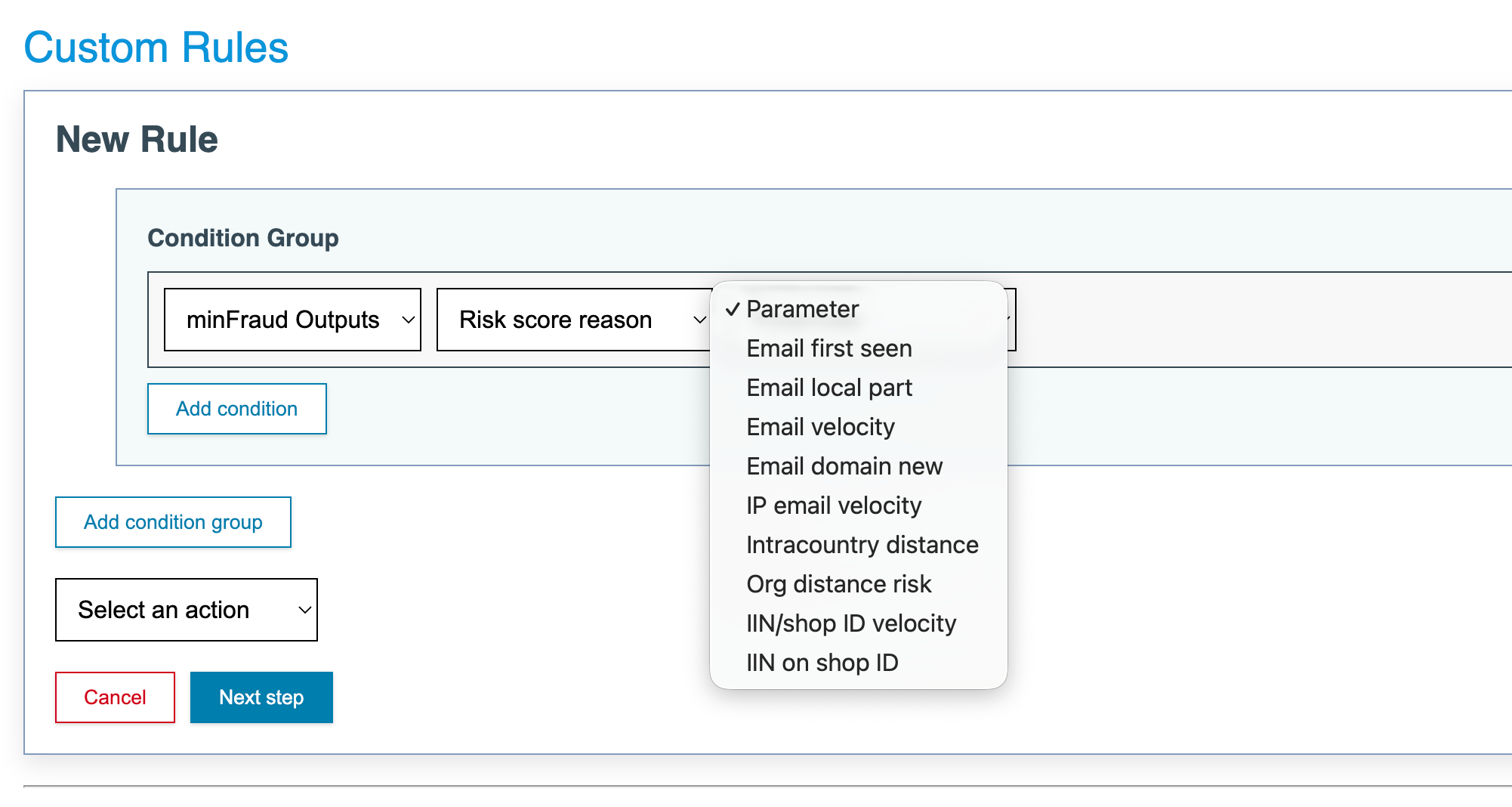
The current risk score reasons able to be used as part of a custom rule are:
- Email first seen
- Email local part
- Email velocity
- Email domain new
- IP email velocity
- Intracountry distance
- Org distance risk
- IIN/shop ID velocity
- IIN on shop ID
If you would like other risk score reasons to be added, please reach out to our Product team at product@maxmind.com.
Transaction classification can now be untagged using the `clear` report tag
May 13, 2026You can now clear a transaction report tag if the initial classification was or
is now incorrect. The new clear tag restores a transaction to an untagged
state. This is distinct from the not_fraud tag which signals the transaction
is legitimate.
Reporting transactions as chargebacks, suspected fraud, spam/abuse, or false positives helps MaxMind detect 10–50% more fraud and reduce false positives for you.
The clear tag is available via the Report Transaction API, the transaction
report web form, and minFraud Interactive.
Native mobile SDKs now available for device tracking
May 13, 2026minFraud device tracking is now available for native Android and iOS apps.
Each SDK and the web-based JavaScript returns a trackingToken you pass as an
input to your minFraud request—a meaningful improvement for mobile networks
where many devices share a single IP.
The MaxMind Device SDK for Android collects device data and sends it to MaxMind so that the minFraud service can assign a Device ID and begin collecting fingerprint information.
The MaxMind Device SDK for iOS collects device data and sends it to MaxMind so that the minFraud service can assign a Device ID and use it to detect fraud across sessions. The SDK exposes both a Swift API and an Objective-C API; Objective-C classes use an MM prefix.
Email addresses and phone numbers to be hashed before storage
May 12, 2026As a security improvement, MaxMind will begin hashing all email addresses and phone numbers submitted to the minFraud service before storing them on our servers. No changes to your integration are required. We will continue to accept plaintext values in API requests, and API responses will be unaffected.
Starting July 6, 2026, minFraud Interactive will display the hashed form of email addresses (plus the plaintext domain) and phone prefixes (the first 6-7 digits identifying country code and carrier) in place of full plaintext values, both in your transaction list and when drilling into individual transactions.
If your team relies on viewing full email addresses or phone numbers during manual review, you can opt in to plaintext display in minFraud Interactive by emailing product@maxmind.com.
You may opt in at any time after the transition date; however, plaintext display will apply only to transactions received after your opt-in date. Transactions processed after July 6 but before your opt-in will remain hashed.
Updates to geolocation confidence factors
March 23, 2026Starting tomorrow, Tuesday, March 24 2026, we’re deploying updates to our geolocation confidence factors to make them more accurate.
For networks located outside of the United States, we will be adjusting country level confidence to be higher in circumstances where those networks are used exclusively in a single country.
For all networks, we will be improving the accuracy of our subdivision, city, and postal confidence. These will be minor changes. Most significantly, some subdivision confidence values of 99 will be reduced to 95.
The following products and services will be improved:
- minFraud Insights web services
- minFraud Factors web services
- GeoIP Insights web service
- GeoIP Enterprise database
Updates to user count data
March 4, 2026Between Tuesday March 3 and Friday, March 6, 2026 (and possibly longer), we are making daily updates to the user count data to more often return a value of 0 or 1 for residential proxies.
Previously, approximately 50% of residential proxy IPs on single household IPs had a user count value of at least 2, and 50% had a value of 0 or 1. This update will make it easier to flag a high volume of customer profiles on a residential proxy as anomalous in relation to a lower user count value of 0 or 1.
Please see an explanation of user counts below:
| User count | Description |
|---|---|
| 0 | IP assigned to a single end-user at a time (household, person, or small business), or not in use. |
| 1 | IP assigned to a single end-user with possibility of multiple end-users. |
| 2 | IP shared with multiple end-users. |
| >5 | IP shared with many end-users. |
Number of minFraud custom inputs increased to 100
February 17, 2026You are now able to add up to 100 custom inputs in minFraud.
Custom inputs allow you to pass data that is relevant to your business and fine-tune minFraud custom rules to help identify suspicious transactions and reduce fraud.
Custom inputs are available to users of all minFraud service tiers: Score, Insights, and Factors.
Updates to autonomous_system_organization, ISP, and organization data
January 28, 2026On January 21, 2026, we released data with significant changes to
autonomous_system_organization and less significant changes to isp and
organization data.
Customers can expect to see in many cases improved, more readable versions of
autonomous_system_organization and, in some cases, small changes to isp and
organization data.
This change is reflected in the following products and services:
- minFraud Insights web service
- minFraud Factors web service
- GeoLite ASN database
- GeoLite City web service
- GeoIP ISP database
- GeoIP Enterprise database
- GeoIP City Plus web service
- GeoIP Insights web service
New email domain outputs in the Insights and Factors web services
December 18, 2025We have added new fields to the
email/domain sub-object
in our minFraud Insights and Factors web services. This enhancement provides you
with more granular data for risk modeling and workflows, which is especially
useful in B2B account opening/onboarding use cases.
These data points will only be returned when you pass the domain or the unhashed email address as an input to the minFraud Insights and Factors web services. Learn more about domain risk data on our knowledge base.
| new output | description |
|---|---|
email/domain/classification | A classification of the domain such as business or education. Read the API specifications for domain classification on our developer portal. |
email/domain/risk | Contains the risk associated with the domain. Read the API specifications for domain risk on our developer portal. |
email/domain/volume | Indicates how much activity we see on an email domain across the minFraud network, expressed in sightings per million. Read the API specifications for domain volume on our developer portal. |
email/domain/first_seen | When an email domain was first seen on the minFraud Network. Read the API specifications for domain tenure tracking on our developer portal. |
email/domain/visit | A sub-object of email/domain that contains information about an automated visit to the email domain such as whether a website on the domain is live. Read the API specifications for domain visit on our developer portal. |
Client APIs have been updated to reflect this change.
Expanded event type inputs, and new payment method and event party inputs
December 18, 2025We have released additional inputs and possible input values for all minFraud web service customers.
| new input | description |
|---|---|
payment/method | The payment method associated with the transaction. View possible values on our developer portal. |
event/party | The party submitting the transaction. Either agent or customer. This input can help reduce false positive potential in cases where an agent is submitting transactions on behalf of customers. Learn more on our developer portal. |
event/type now supports the additional values below.
View the full list of possible values for event/type on our developer portal.
| additional input | description |
|---|---|
credit_application | The transactor is attempting to submit an application for credit. |
fund_transfer | The transactor is attempting to transfer funds from one account to another. |
sim_swap | For mobile network operators. A new SIM card or eSIM is being issued to activate service on a customer’s existing phone number. |
Passing the additional inputs above can help us improve our risk scoring accuracy for you by increasing the context available to our machine learning models and heuristics.
Our client APIs have been updated to support these inputs so you may need to refresh yours to submit them in your minFraud requests if you are not interfacing directly with our REST API.
Subdivision, city, and postal fields blanked in additional countries
December 17, 2025Effective tomorrow, Thursday, December 18, 2025, we will be blanking out the subdivision, city, and postal fields more often in the following countries. This change will result in fewer resolutions in:
- Amman, Jordan
- Budapest, Hungary
- Reykjavik, Iceland
- All cities in Austria
- All cities in South Africa
- All cities in Vietnam
We will also be blanking out city and postal fields more often for cell networks in:
- India
- Mexico
- United States
This change is to reduce false positives when the end users of a network are dispersed all over the country.
The update will be reflected in the following products and services:
- minFraud Factors web service
- minFraud Insights web service
- GeoIP City database
- GeoIP Enterprise database
- GeoIP City Plus web service
- GeoIP Insights web service
Subdivision, city, and postal fields blanked in additional countries
November 28, 2025Effective Monday, December 1, 2025, we will be blanking out the subdivision, city, and postal fields more often in the following countries. This change will result in fewer resolutions in:
- Belgium
- Israel
- Italy
- The Netherlands
- Portugal
- Sweden
- Ukraine
We will also be blanking out city and postal fields more often for cell networks in:
- Canada
- United States
This change is to reduce false positives when the end users of a network are dispersed all over the country. Many of the networks affected by this change are cell networks, which are often allocated across a wide area spanning one or more subdivisions.
The update will be reflected in the following products and services:
- minFraud Factors web service
- minFraud Insights web service
- GeoIP City database
- GeoIP Enterprise database
- GeoIP City Plus web service
- GeoIP Insights web service
IP risk snapshot output added to traits object in the Insights web services
November 20, 2025We have added the
ip_risk_snapshot
to the traits object in our GeoIP Insights web service and our minFraud Insights
and Factors web services. This field contains the risk associated with the IP
address. The value ranges from 0.01 to 99. A higher score indicates a higher
risk.
The IP risk snapshot is not a replacement for the minFraud IP risk score
(ip_address/risk).
The IP risk snapshot is based on an analysis of historical risk on the IP address, while the minFraud IP risk score is a responsive data field that generates an IP risk score in real time based on the transactions you send and activity from across the minFraud network.
minFraud customers may find the IP risk snapshot output useful to determine
whether an IP address is risky based on historical activity versus a current,
emerging issue. A lower traits/ip_risk_snapshot score combined with a higher
minFraud ip_address/risk score would mean that the IP address is becoming
risky in real time based on the traffic on your and other customers’ networks. A
high score in both ip_risk_snapshot and minFraud IP risk score would mean that
the IP address has been risky for a longer time.
Client APIs have been updated to reflect this change.
New anonymizer data added to web services
November 19, 2025We have added an
anonymizer object to our web
services. This object contains the anonymizer data previously found in the
traits object together with new outputs.
Anonymizer data in the traits object is being marked as deprecated. However,
for backwards compatibility, anonymizer data in the traits object will
continue to be populated and the functionality remains the same. This will not
be a breaking change.
We recommend updating your integrations to use the new anonymizer object,
which contains data points not found in the traits object:
| new data | description |
|---|---|
anonymizer/confidence | A score ranging from 1 to 99 that represents our percent confidence that the network is currently part of an actively used VPN service. |
anonymizer/network_last_seen | The last day that the network was sighted in our analysis of anonymized networks. This is in the ISO 8601 date format (YYYY-MM-DD). |
anonymizer/provider_name | The name of the VPN provider (e.g., nordvpn, surfshark) associated with the network. |
Client APIs have been updated to reflect this change, which applies to the following web services:
- minFraud Insights
- minFraud Factors
- GeoIP Insights
Subdivision, city, and postal fields blanked in selected cities and countries
November 18, 2025Effective tomorrow, Wednesday, November 19, 2025, we will be blanking out the subdivision, city, and postal fields more often in the following cities and countries. This change will result in fewer resolutions in:
- Bangkok, Thailand
- Istanbul, Turkey
- All cities in Argentina
- All cities in France
- All cities in Germany
- All cities in Ireland
- All cities in Poland
- All cities in South Korea
- All cities in Switzerland
- All cities in Taiwan
- All cities in the United Kingdom
- All cities in Uruguay
This change is to reduce false positives when the end users of a network are dispersed all over the country.
The update will be reflected in the following products and services:
- minFraud Factors web service
- minFraud Insights web service
- GeoIP City database
- GeoIP Enterprise database
- GeoIP City Plus web service
- GeoIP Insights web service
Subdivision, city, and postal fields blanked in selected large cities
November 6, 2025Effective Monday, November 10, 2025, we will be blanking out the subdivision, city, and postal fields more often in Austria, Denmark, Greece, Ireland, Norway, Spain, and Sweden where the end users are actually dispersed all over the country.
This change will result in fewer resolutions to the following cities:
- Vienna, Austria
- Copenhagen, Denmark
- Athens, Greece
- Dublin, Ireland
- Oslo, Norway
- All cities in Spain
- Stockholm, Sweden
The update will be reflected in the following products and services:
- minFraud Factors web service
- minFraud Insights web service
- GeoIP City database
- GeoIP Enterprise database
- GeoIP City Plus web service
- GeoIP Insights web service
Subdivision, city, and postal fields blanked in Tokyo metro area in some cases
November 6, 2025As of Tuesday, November 4, 2025, we are blanking out the subdivision, city, and postal fields in cases where the subdivision was previously mapped to Tokyo but end users are dispersed throughout Japan.
This change will result in fewer resolutions to the Tokyo subdivision and will be reflected in the following products and services:
- minFraud Factors web service
- minFraud Insights web service
- GeoIP City database
- GeoIP Enterprise database
- GeoIP City Plus web service
- GeoIP Insights web service
EMAIL_DOMAIN_CREATION_DATE risk score reason added
June 16, 2025We have added EMAIL_DOMAIN_CREATION_DATE as a new
risk score reason.
The EMAIL_DOMAIN_CREATION_DATE risk reason will be returned as either
EMAIL_DOMAIN_CREATION_DATE raised the overall risk score or
EMAIL_DOMAIN_CREATION_DATE lowered the overall risk score to clearly indicate
the effect the reason has on the score.
Please email product@maxmind.com if you have any questions.
Resolved - Postal code validation bug
May 5, 2025We have resolved the bug that resulted in a number of incorrect and invalid values for postal codes.
Postal code validation bug
May 1, 2025We have identified a bug with postal code validation in our database build process.
This bug is resulting in a number of incorrect and invalid values for postal codes. We are working on a fix.
The following products and services are impacted:
- minFraud Insights
- minFraud Factors
- minFraud Legacy
- GeoIP Insights web service
- GeoIP City Plus web service
- GeoIP City database
- GeoIP Enterprise database
Risk score reasons out of beta
February 24, 2025Risk score reasons have been officially introduced and out of beta as of February 19, 2025.
Available for all minFraud service tiers for individual transactions on the Transaction Details page and also via API for the minFraud Factors service, risk score reasons provide specific and understandable reasons for why a risk score is high or low, helping to uncover risk patterns for individual transactions and the overall transaction stream, both at a point in time and over time.
Read our blog post to learn about the ‘why’ behind risk score reasons, and how you can use the data they provide to enhance your fraud strategy.
No longer returning A1 country code in minFraud legacy web services
February 10, 2025For minFraud legacy web services, we will no longer return A1 as a country
code.
This change is due to the removal of long-deprecated fields in our GeoIP databases. See our GeoIP release note for more information.
Several Spectrum Business networks reclassified
December 3, 2024In data released today, Tuesday, December 3, 2024, we are updating a large
number of Spectrum Business networks to be classified as Spectrum residential
networks. For these networks, the ISP name will change from Spectrum Business
to Spectrum. This change has been reviewed, and is accurate.
This change will be reflected in the following products and services:
- minFraud Factors web service
- minFraud Insights web service
- GeoIP Enterprise database
- GeoIP ISP database
- GeoIP Insights web service
- GeoIP City Plus web service
Updates to Risk Score Reasons (beta)
November 12, 2024On November 13, 2024, we will release a number of updates to risk score reasons:
- All reasons will be updated to say
[reason] raised the overall risk scoreor[reason] lowered the overall risk scoreto more clearly indicate the effect of a reason. - The
EMAIL_ADDRESS_NEWreason code will be removed and replaced with three distinct and more specific codes and reasons:EMAIL_FIRST_SEENEMAIL_TENUREEMAIL_TENURE_NO_ACTIVITY
- The
CUSTOMER_IDreason code will be renamed toCUSTOMER_ID_ACTIVITYto better fit its reason description.
Please email product@maxmind.com if you have any questions.
Deprecation of risk factor scores/subscores
October 22, 2024On Monday, November 4, 2024, we will be deprecating the risk factor scores/ subscores data in the minFraud Factors service. Risk factor scores/subscores will be removed from the API response in March, 2025.
Risk factor scores have been replaced by risk score reasons, to help you more deeply understand your risk patterns and make more informed decisions. Please review the risk score reasons for specific and understandable insights into why a risk score is high or low. Learn more about risk score reasons on our Knowledge Base.
Submit a support ticket request if you have questions or concerns.
Upcoming improvements to user count data
October 9, 2024On Tuesday, October 22, 2024, we will release an improvement to our user count data to better detect IPs with multiple end users.
Many IP addresses with multiple end users that previously had a user count value of 0 or 1 will now have a value of 2.
If you have applications of the data that rely on user count values with a threshold of 0, 1, or 2, you may want to increase the thresholds by 1. For example, if you currently consider user count values of greater than 1 to be high volume, you may wish to consider user count values of greater than 2 to be high volume when this update goes live.
The following services will be impacted:
- minFraud Insights web service
- minFraud Factors web service
Learn more about user count data on our Knowledge Base.
Submit a support ticket request if you have questions or concerns.
Increase in slightly elevated IP risk and proxy scores and remediation
September 12, 2024On September 10, 2024 we pushed a model update to IP risk scoring that increased a large volume of IP risk scores (also referred to as proxy score for legacy services) at the lower end of the scale (between 0.01 and 1).
While these IP risk scores remained low (less than 1), this shifted the score distribution and may have impacted your systems depending on your score thresholds.
On September 12, 2024, we implemented an update that will decrease most of these low IP risk scores again. To remediate this sort of issue in the future, we will be increasing the sensitivity of our monitoring for scores on the lower end of the distribution before releasing model updates.
Introducing Risk Score Reasons beta for minFraud Factors customers
August 27, 2024Today, we have released a new beta feature that will help minFraud Factors customers more deeply understand risk patterns and make more informed decisions.
Risk score reasons are a set of data that provide users with specific and understandable reasons for why a risk score is high or low. This data is exclusive to the minFraud Factors service.
Watch this 2-minute video to learn more.
For full details, including how to access and test this feature, check out the Risk Score Reasons knowledge base article.
To provide feedback on Risk Score Reasons, please email customersuccess@maxmind.com to schedule a feedback session.
MaxMind minFraud alert emails now include instant feedback links
August 15, 2024MaxMind minFraud alert emails now include links that allow you to provide instant feedback on each request. Providing transaction feedback helps improve the risk scoring for your account.
You can mark a request as risky and we will raise the risk for similar requests.
Or, you can mark a request as not risky and we will lower the risk for similar requests.
Here is an example of the links in the minFraud alerts email body.

Please continue to report chargebacks and fraud on your account portal or via API.
Additional filtering options now available for minFraud transactions
August 8, 2024The transactions screen in your MaxMind account portal now has expanded filtering options, giving you added ability to discover trends in your transactions and adjust risk strategies.
You can now filter transactions by:
- Risk score range: the likelihood that a transaction is fraudulent, scored between a minimum of 0.01 and a maximum of 99
- IP risk score range: the riskiness of an IP address, scored between a minimum of 0.01 and a maximum of 99
- ISP: the internet service provider of the end-user who initiated the transaction
- IP Country: the country for the IP address associated with the transaction
New phone outputs released for minFraud® Insights and minFraud Factors
July 9, 2024We have released additional outputs for our minFraud Insights and minFraud Factors web services. Insights and Factors customers that pass phone numbers can now make use of the following additional outputs:
/shipping_phone/country– A two-character ISO 3166-1 country code for the country associated with the shipping phone number./shipping_phone/is_voip– This is true if the shipping phone number is a Voice over Internet Protocol (VoIP) number allocated by a regulator. It is false if the shipping phone number is not a VoIP number allocated by a regulator. The key is only present when a valid shipping phone number has been provided and we have data for it./shipping_phone/network_operator– The name of the original network operator associated with the shipping phone number. This field does not reflect phone numbers that have been ported from the original operator to another, nor does it identify mobile virtual network operators./shipping_phone/number_type– Indicates whether the phone number is mobile or fixed./billing_phone/country– A two-character ISO 3166-1 country code for the country associated with the billing phone number./billing_phone/is_voip– This is true if the billing phone number is a Voice over Internet Protocol (VoIP) number allocated by a regulator. It is false if the billing phone number is not a VoIP number allocated by a regulator. The key is only present when a valid billing phone number has been provided and we have data for it./billing_phone/network_operator– The name of the original network operator associated with the billing phone number. This field does not reflect phone numbers that have been ported from the original operator to another, nor does it identify mobile virtual network operators./billing_phone/number_type– Indicates whether the phone number is mobile or fixed.
These values are particularly helpful to identify mismatches between data points, such as a mismatch between the billing country as indicated by the IP address and the country as indicated by the billing phone number. Another strong signal for fraud is a phone carrier that does not operate in the country indicated by the IP address.
Our client APIs have been updated to support these outputs so you may need to refresh yours if you are not interfacing directly with our REST API.
Email first seen can be used as a parameter for custom rules
April 8, 2024minFraud Insights and Factors customers can now use the
/email/first_seen output
in minFraud custom rules.
The minFraud service retains a record of when an email address or email domain was first seen on the minFraud Network. An email address that has been conducting transactions for a long time across the minFraud Network may be more trustworthy than a new email address created within the last 30 days.
You can select the email first seen output as a parameter in custom rules by selecting minFraud outputs > Email first seen when defining a new condition for a custom rule.
Upcoming changes to our TLS certificates may impact customers with unusual server configuration
April 8, 2024Starting in May, Let’s Encrypt will no longer use a cross-signed root
certificate, and the primary TLS certificate handling the *.maxmind.com
domains will be impacted by this change.
Most customers will see no impact from this change.
This change should only be of concern if the servers interacting with MaxMind domains are running a very old or out of date operating system, or if you manage your own local Certificate Authority store.